01
Not simply a cyst
A visual anatomy atlas for everyday questions
Start with what you know: where it is, what it feels like, or what may be happening beneath the skin.
Educational guidance only. It cannot diagnose you.
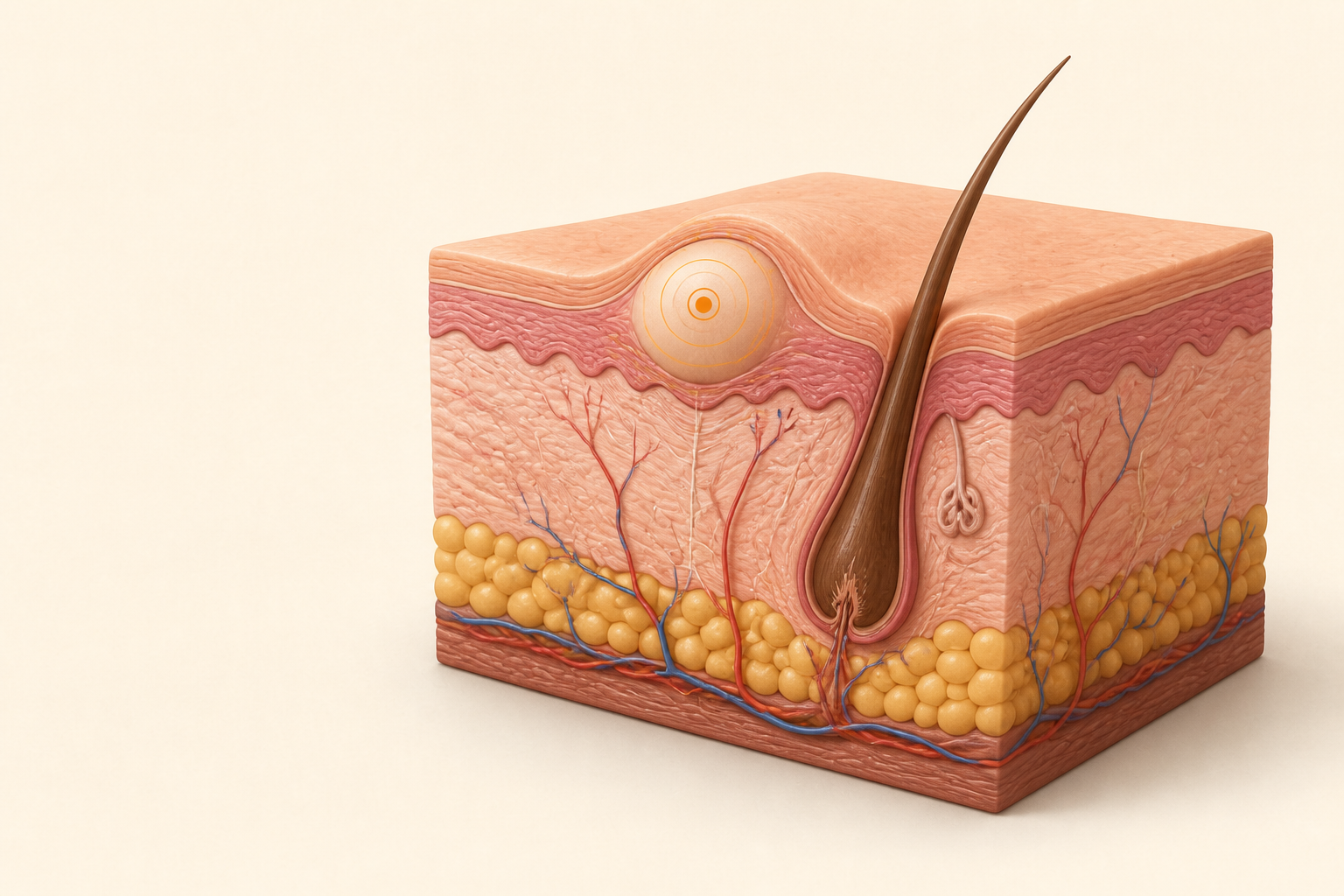 Skin surface → deeper tissuedepth changes the story
Interactive atlas
Location is a useful clue—never a diagnosis. Rotate the body or use the accessible region list.
Preparing the body atlas
Same surface, different structure
Keep every scene at the same scale, then compare its origin, depth, and pattern.
Not simply a cyst
Not simply a cyst
True cyst family
English • Urdu • Roman Urdu
Say where the lump is and what you have noticed. Everyday words like daana, phinsi, phora, and gilti are kept as clues—never turned into a diagnosis.
DescribeUse ordinary language
Check safetyRules run before matches
LearnGet sourced comparisons
Educational guidance only. It cannot diagnose you.
Condition library
Browse every curated lesson in the superficial-skin atlas. Each one explains where a pattern begins, what may help, and what not to do.
A usually slow-growing sac beneath the skin filled with keratin; it is often imprecisely called a “sebaceous cyst.”
Surface skin cells form a sac in the skin rather than shedding normally at the surface.Inflammation around one or more hair follicles that can look like small acne-like bumps.
The inflammation is centred on a hair follicle near the skin surface.A hair that curves or grows back into the skin, producing a small local bump and inflammation.
A cut or emerging hair enters nearby skin instead of growing freely away from the surface.A boil is a painful pus-filled infection around a hair follicle; a carbuncle is a connected group of boils.
Infection extends from a hair follicle into nearby skin; grouped connected boils form a carbuncle.A painful lump or swelling in the skin that contains pus and may require clinician drainage.
A localized pus collection forms within skin or nearby soft tissue, often after microbes enter through a break or follicle.A pit or tunnel at the top of the buttock cleft that can contain hair and may become inflamed or form an abscess.
A small opening and sinus tract develop in the natal cleft; loose or inward-pushed hair can collect in the tract.A long-term inflammatory skin condition that can cause repeated painful lumps, abscess-like lesions, drainage, tunnels, and scarring in skin folds.
Inflammation develops around hair follicles in characteristic fold areas and can extend into tunnels beneath the skin.A perianal abscess is an infected pus collection near the anus; a fistula is an abnormal channel that can remain between the anal canal and skin.
Infection can begin in a small anal gland and create a pus pocket; a channel may persist after drainage.A blocked Bartholin duct can form a fluid-filled lump near one side of the vulvar opening; infection can turn it into a painful abscess.
Fluid collects when the duct from a Bartholin gland near the vulvar opening is blocked; infection can create an abscess.A noncancerous fluid-filled lump that most often develops near a wrist or hand joint or tendon.
A fluid-filled sac forms next to a joint or tendon sheath and can connect through a small stalk.A deep inflammatory acne lesion caused by a blocked follicular unit; nodules are firm while some lesions described as acne cysts contain fluid.
Oil, shed cells, inflammation, and microbes interact within a blocked hair follicle and can produce a deep lesion.A usually harmless, slow-growing lump made of fat beneath the skin—not a cyst.
A localized growth of mature fat cells develops in the subcutaneous layer.An enlarged immune-system node beneath the skin—not a cyst—often noticed in the neck, armpit, or groin.
A lymph node within the immune and lymphatic system enlarges, commonly while responding to nearby illness or inflammation.Swollen vascular tissue in or around the anus—not a cyst—shown only to clarify a commonly confused location.
Vascular cushions in the anal canal become enlarged or symptomatic.Evidence & scope
Why this atlas is focused: LumpMap 3D covers common visible or palpable superficial lumps. Internal-organ cysts, including ovarian, kidney, liver, pancreatic, and brain cysts, require a different kind of medical product and often imaging.
always pair learning with clinical care